Amid a general decline on the large-tonnage shipping market accelerated by Easter lull, the rates in all tonnage groups have either got stuck within the last done levels or kept sliding down in both hemispheres. In particular, while the Global HFI has held totally unchanged, the Global PFI has sagged by $0.27/t and the Global CapeFI by $0.56/t after April 14. In such circumstances, the Baltic Dry Index dropped by 41 points to 1,241 points as of Thursday, April 17, and no updates have been made since then. The small-tonnage freight market has also remained quiet and depressed, tonnage-cargo ratio imbalanced in all regions. Therefore, the Global CFI has fallen by another $0.18/t.
After the last week’s rapid plunge, prices for all types of bunker fuel have showed a U-turn to quite a considerable increase, which worsens an already unexciting situation for ship owners.
Given pretty mixed trends on the commodity markets under review, the Global ISM Commodity Index has not changed much over the week.
Generally saying, grain prices have fallen in Western Europe and the Black Sea region, but risen in South and North America. In particular, price reductions for Ukrainian wheat are triggered by seasonal factors, while corn increased its value thanks to lively demand from the EU and Turkey. Importers’ interest in Russian wheat remains moderate despite lower prices. Meanwhile, tenders in the Middle East and Africa supported quotes for EU-origin wheat. US corn and soybeans enjoy steady demand in Mexico, which gives traders green light to raise prices. Price hikes in the US buoyed up quotes for South American corn and soybeans despite a bit weaker interest from China.
The metallurgical market can be called sluggish. Iron ore segment started week with a price growth, but exporters had to reduce quotes closer to weekend given muted demand from China. Turkish mills do not show interest in purchasing imported scrap due to dull sales of finished steel products. Demand for Russian HRC and billets is almost zero in Turkey given reduced quotes for scrap and rebar. Trade in billets and HRC has totally stalled in SE Asia, as importers left the market for long holidays. Despite significant price cuts, oversea sales of Turkish rebar are sporadic.
The situation on the global coal market is ambiguous this week. Growing coal indices support quotes for imported thermal coal in Western Europe. Prices for Russian coal have inched up in Turkey despite muted demand. Active sales to India are driving up South African coal prices. At the same time, Australian exporters reduced quotes in order to spur sales to China.
Oversea trade in nitrogen fertilizers remains quiet. The announcement of results of the Indian tender failed the support the urea segment, so Egyptian, Middle Eastern and Russian exporters have to reduce the corresponding quotes due to sluggish demand. Russian AN prices have totally stalled, fresh deals are occasional. At the same time, brisk sales of DAP and MAP with June shipments from Russia and Morocco allow exporters to set considerably higher quotes. Despite moderate trade, Chinese exporters have raised AS prices, following the general uptrend in the phosphorous fertilizer segment.
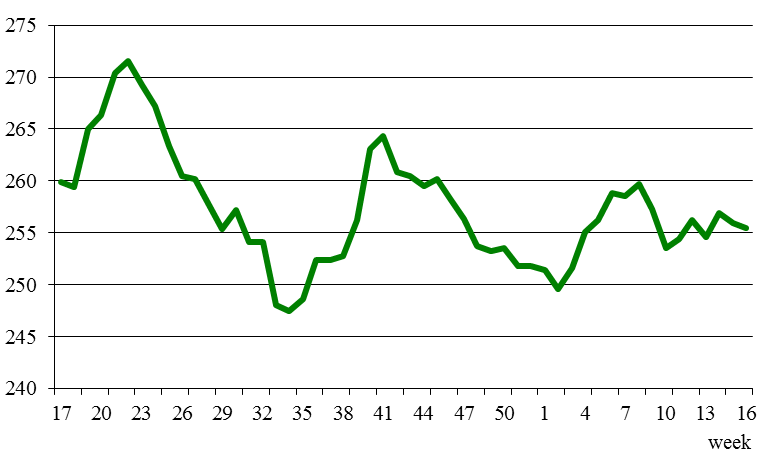 Global ISM Dry Commodity Index* for Handy/Supra market
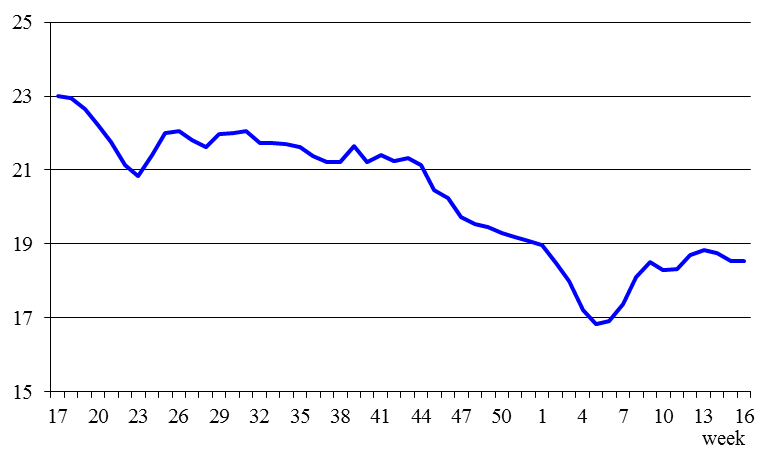 Global HFI
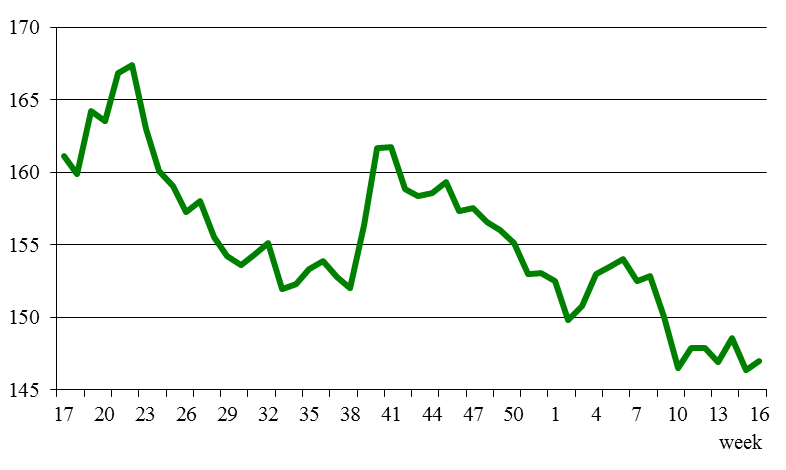 Global ISM Dry Commodity Index* for Panamax market
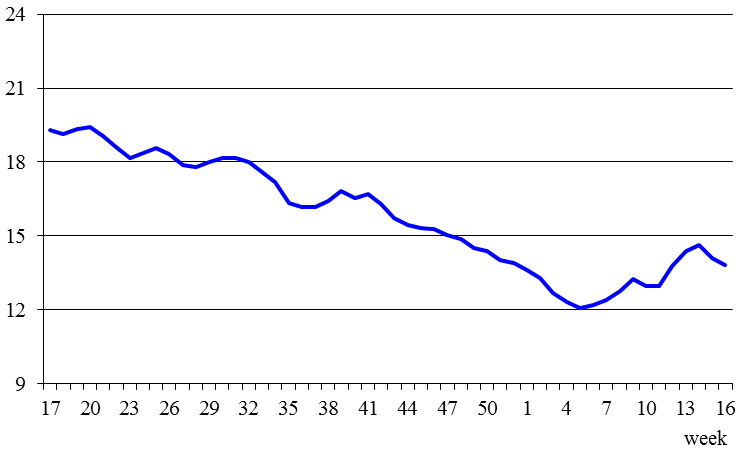 Global PFI
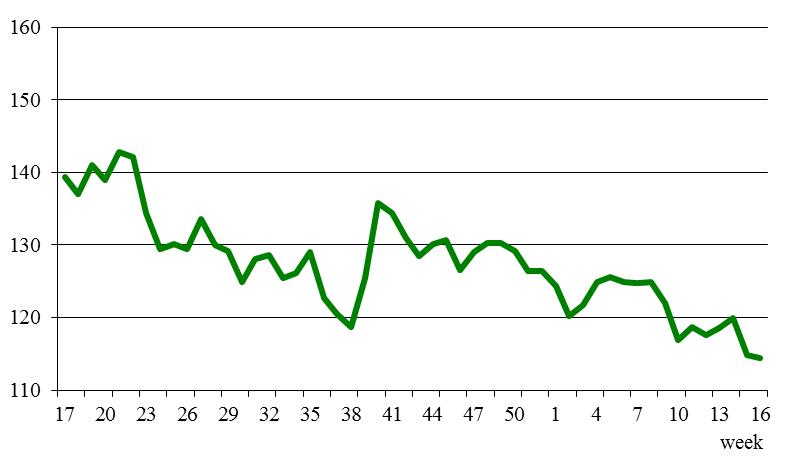 Global ISM Dry Commodity Index* for Capesize market
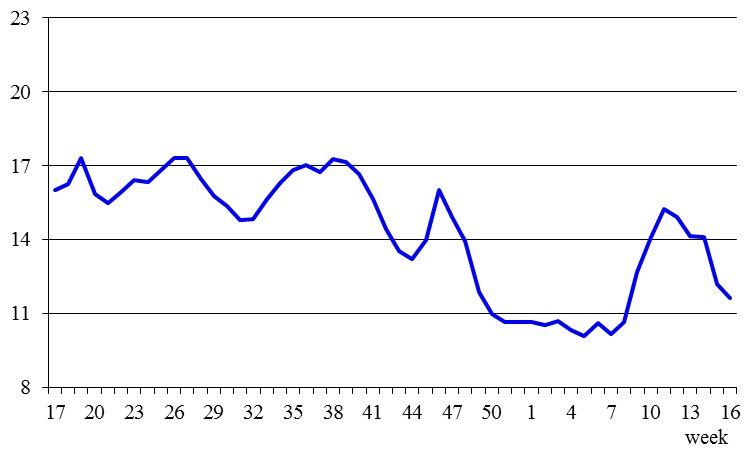 Global CapeFI
* - Commodity Index was designed by ISM as a tool to determine the complex commodity market situation and, therefore, to predict future shipping activity within certain tonnage classes. ISM Commodity Index is a weighted average of export prices for main types of dry cargoes, such as grain, steel, coal, fertilizers, raw materials.
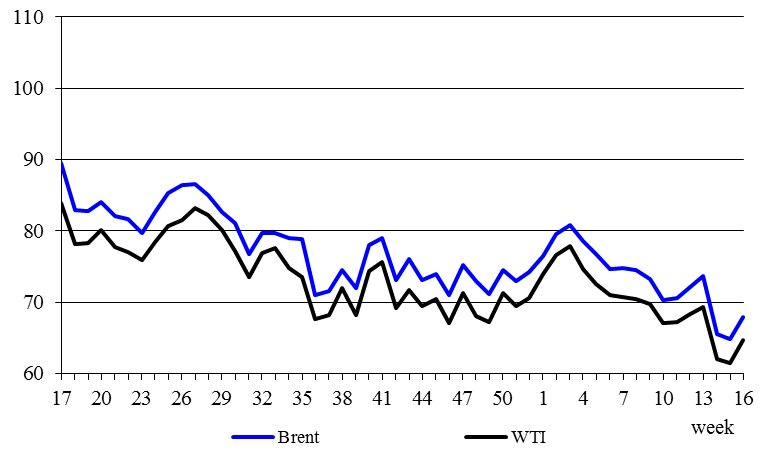 Crude oil futures, $/bbl
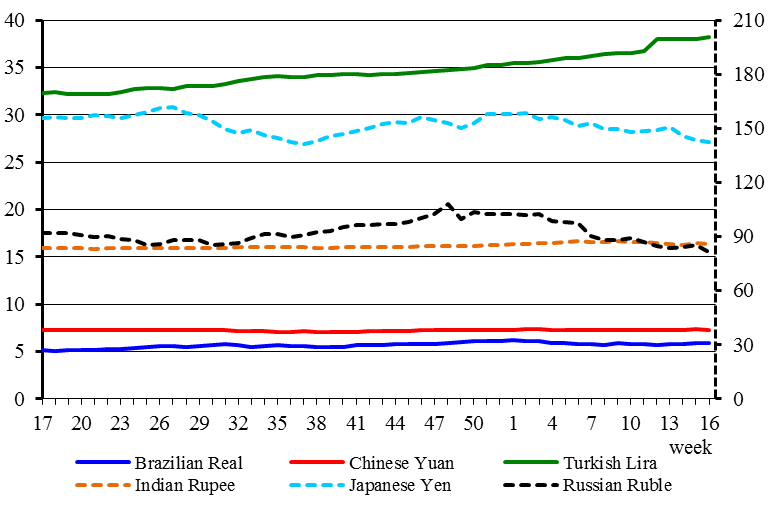 Currency rates dynamics (BRL, CNY, TRY, JPY, INR, RUB to USD)**
** - Due to different numerical order, Brazilian Real (BRL), Chinese Yuan (CNY), Turkish Lira (TRY) currency rates are shown within the main (left) scale, while Indian Rupee, Japanese Yen and Russian Ruble are shown within the secondary (right) scale. Time scale (week number) is a common one with latest rates shown to the right of the graph for all of 6 currencies.